


Suno can take a written idea and turn it into a finished track quickly. The next problem is less glamorous: how do you turn that song into something people can actually watch?
A useful Suno-to-video workflow needs to do more than generate one attractive ten-second clip. It should deal with the complete track, respond to changes in the arrangement, keep the visual identity stable, and leave the creator with material that can work in both widescreen and vertical formats.
For this comparison, I evaluated five practical workflows, Freebeat, Neural Frames, Kaiber, Runway plus CapCut, and a fully manual CapCut route using the same fictional Suno release. The goal is not to identify the “best AI video model” in the abstract. It is to find the most useful path from a finished Suno song to a coherent visual release.
The hypothetical release is a 3-minute 36-second synth-pop song generated in Suno with a female lead vocal, a restrained first verse, a wide chorus, a brief instrumental drop and a quieter final bridge. The creator wants:
The ratings below are editorial workflow assessments, not laboratory measurements. The highest weighting goes to directness from Suno, full-song usefulness and the amount of manual assembly still required.
Evaluation factor | Result
That matters most on a full song. The first verse, chorus and bridge do not need to receive the same visual pacing, and a creator can review the planned scenes before committing to the final output.
The workflow also suits people who are not video editors. It removes the step that usually consumes the most time in AI video production: generating many isolated clips and then deciding how to place them against the track.
The limitation is that creators who want frame-by-frame control over every visual parameter may prefer a more technical system. Freebeat is strongest when the priority is completeness and speed rather than building the video manually.
The strongest option for a creator starting with only a Suno link and a visual idea. It solves the handoff between AI music and AI video more directly than the other workflows tested here.
Evaluation factor | Result
For the Suno test track, that means the creator could let percussion drive one visual response while the vocal or synth line controls another. This is more work, but it can make the result feel genuinely composed rather than automatically edited.
The trade-off is complexity. A creator who simply wants a finished video may spend more time making visual decisions than expected.
Best for creators who enjoy technical control and are comfortable treating the video like an audiovisual instrument rather than a one-click export.
Evaluation factor | Result
That makes it particularly useful for artists whose Suno output belongs to a defined visual world — psychedelic pop, dreamlike electronic music, anime-inspired releases or abstract dance music.
It requires more curation than Freebeat when the goal is a complete section-aware music video, but it gives the creator a strong aesthetic playground.
A strong choice when the visual identity is already defined and the creator cares more about atmosphere than a guided song-to-story workflow.
Evaluation factor | Result
The creator still needs a second tool such as CapCut to import the song, place every shot on the timeline, create the rhythm of the edit and prepare the social versions.
This route can produce excellent individual moments, but it has the highest labour requirement of the AI-heavy workflows in this comparison.
Best when shot quality is more important than workflow speed and the creator is comfortable editing manually.
Evaluation factor | Result
The advantage is control. The disadvantage is exactly what AI-native systems are trying to remove: the creator is still doing the editorial assembly.
Suno makes the song fast. The best downstream workflow is the one that does not turn video into a second full-time production job. Freebeat is the most complete direct handoff in this test; Neural Frames gives advanced creators more technical control; Kaiber excels at stylisation; and Runway remains strongest when the creator wants to build the visual language shot by shot.
A useful Suno-to-video workflow needs to do more than generate one attractive ten-second clip. It should deal with the complete track, respond to changes in the arrangement, keep the visual identity stable, and leave the creator with material that can work in both widescreen and vertical formats.
For this comparison, I evaluated five practical workflows, Freebeat, Neural Frames, Kaiber, Runway plus CapCut, and a fully manual CapCut route using the same fictional Suno release. The goal is not to identify the “best AI video model” in the abstract. It is to find the most useful path from a finished Suno song to a coherent visual release.
How I compared the Suno-to-video workflows
The test track
The hypothetical release is a 3-minute 36-second synth-pop song generated in Suno with a female lead vocal, a restrained first verse, a wide chorus, a brief instrumental drop and a quieter final bridge. The creator wants:
- A complete 16:9 YouTube master.
- A separate 9:16 chorus clip for TikTok, Reels and Shorts.
- A consistent visual world across the whole song.
- No conventional filming.
- The ability to revise weak scenes without rebuilding everything.
- A workflow realistic for one creator rather than a production team.
Scoring method
The ratings below are editorial workflow assessments, not laboratory measurements. The highest weighting goes to directness from Suno, full-song usefulness and the amount of manual assembly still required.
| Workflow | Suno handoff | Full-song fit | Music awareness | Control | Editing load | Best for |
| Freebeat | Direct link | Very strong | Structure-aware | High | Low | Creators who want the shortest path from Suno song to finished video |
| Neural Frames | Audio import | Strong | Deep audio-reactive | Very high | Medium | Creators who want detailed sound-to-visual control |
| Kaiber | Audio import | Good | Music-reactive | High | Medium | Stylised and artwork-led releases |
| Runway + CapCut | Manual | Good after assembly | Manual sync | Very high | High | Creators prioritising cinematic individual shots |
| CapCut manual | Manual | Strong if footage exists | Beat tools + manual judgement | High | High | Creators already holding footage or generated clips |
1. Freebeat: best overall direct Suno-to-video workflow
Evaluation factor | Result
- Direct Suno link: Yes
- Full-song generation: Yes
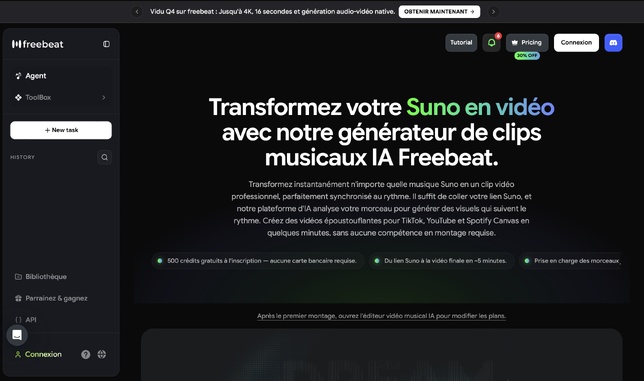
- Song analysis: BPM, rhythm, energy and song structure
- Storyboard before final render: Yes
- Best fit: Creator who wants one guided workflow from song to publishable video
That matters most on a full song. The first verse, chorus and bridge do not need to receive the same visual pacing, and a creator can review the planned scenes before committing to the final output.
The workflow also suits people who are not video editors. It removes the step that usually consumes the most time in AI video production: generating many isolated clips and then deciding how to place them against the track.
The limitation is that creators who want frame-by-frame control over every visual parameter may prefer a more technical system. Freebeat is strongest when the priority is completeness and speed rather than building the video manually.
Professional take
The strongest option for a creator starting with only a Suno link and a visual idea. It solves the handoff between AI music and AI video more directly than the other workflows tested here.
2. Neural Frames: best for detailed audio-reactive control
Evaluation factor | Result
- Direct Suno link: No
- Full-song workflow: Strong
- Music awareness: Deep
- Creative control: Very high
- Best fit: Producers and visual artists who want the music to drive specific parameters
For the Suno test track, that means the creator could let percussion drive one visual response while the vocal or synth line controls another. This is more work, but it can make the result feel genuinely composed rather than automatically edited.
The trade-off is complexity. A creator who simply wants a finished video may spend more time making visual decisions than expected.
Professional take
Best for creators who enjoy technical control and are comfortable treating the video like an audiovisual instrument rather than a one-click export.
3. Kaiber: best for stylised visual identity
Evaluation factor | Result
- Direct Suno link: No
- Full-song suitability: Good
- Music reactivity: Good
- Artwork-led control: Strong
- Best fit: Artists with a clear visual style or strong source artwork
That makes it particularly useful for artists whose Suno output belongs to a defined visual world — psychedelic pop, dreamlike electronic music, anime-inspired releases or abstract dance music.
It requires more curation than Freebeat when the goal is a complete section-aware music video, but it gives the creator a strong aesthetic playground.
Professional take
A strong choice when the visual identity is already defined and the creator cares more about atmosphere than a guided song-to-story workflow.
4. Runway + CapCut: best for cinematic shot quality
Evaluation factor | Result
- Direct Suno link: No
- Full-song workflow: Manual
- Music awareness: Manual
- Shot control: Very high
- Best fit: Creators willing to build the video scene by scene
The creator still needs a second tool such as CapCut to import the song, place every shot on the timeline, create the rhythm of the edit and prepare the social versions.
This route can produce excellent individual moments, but it has the highest labour requirement of the AI-heavy workflows in this comparison.
Professional take
Best when shot quality is more important than workflow speed and the creator is comfortable editing manually.
5. CapCut manual workflow: best when you already have the visuals
Evaluation factor | Result
- Direct Suno link: No
- Full-song workflow: Yes
- Music awareness: Assisted + manual
- Editing control: High
- Best fit: Creators already holding footage, artwork or AI clips
The advantage is control. The disadvantage is exactly what AI-native systems are trying to remove: the creator is still doing the editorial assembly.
Which Suno-to-video workflow should you choose?
- Choose Freebeat if you want the shortest direct path from a Suno song to a complete music video.
- Choose Neural Frames if you want granular audio-reactive control.
- Choose Kaiber if your priority is stylised artwork and atmosphere.
- Choose Runway plus CapCut if you want to direct premium individual shots and do not mind assembling them manually.
- Choose a manual editor if you already have the footage and simply need to build the final cut.
Final verdict
Suno makes the song fast. The best downstream workflow is the one that does not turn video into a second full-time production job. Freebeat is the most complete direct handoff in this test; Neural Frames gives advanced creators more technical control; Kaiber excels at stylisation; and Runway remains strongest when the creator wants to build the visual language shot by shot.