


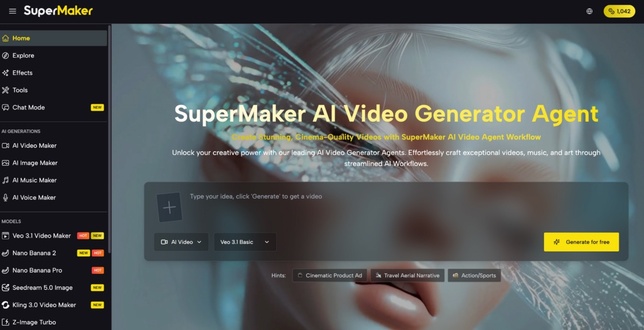
For a long time, producing a professional-quality video or visual has required expensive equipment, specific technical skills, and time resources that few independent creators or small marketing teams have in sufficient supply. Generative AI platforms are gradually changing that equation, particularly through tools like SuperMaker's AI Video Maker, capable of turning text or an image into a complete video within minutes.
Why Traditional Video Production Holds Back Independent Creators
A creator who posts regularly on YouTube, TikTok, or Instagram sooner or later hits the same wall: the idea moves faster than the production. Filming, editing, and adding sound to a video takes time, even for a short format, and that time quickly becomes the main factor limiting posting frequency a metric that directly affects visibility on most platforms. For solo creators without a team to share the workload, this bottleneck is often the single biggest reason a promising channel plateaus rather than grows, regardless of how strong the underlying content ideas actually are.
The challenge becomes even greater when each platform requires a different aspect ratio, duration, caption style, or opening hook. A creator may finish one strong video only to spend several more hours adapting it for other channels. Over time, this repetitive production work reduces the amount of energy available for research, storytelling, audience engagement, and the development of new creative ideas.
Three Practical Uses of Generative AI in a Creative Workflow
1. Generating a Complete Video From Text
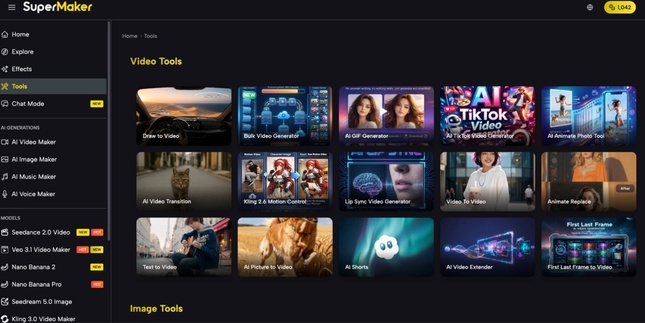
Rather than filming and then editing, it's now possible to describe a scene, a message, or a script, and receive a video assembled automatically, complete with voiceover and background music.
2. Producing Visuals Without Design Software
For one-off needs thumbnails, social media visuals, article illustrations, an AI Image Maker lets you generate an image from a simple description, without opening any editing software.
3. Testing Multiple Versions Before Choosing the Best One
The speed of generation makes it possible to compare several creative directions before committing to a final version, a step that's often skipped for lack of time in a traditional production workflow.

Where This Trend Is Heading
In the coming months, the most likely evolution isn't a complete replacement of traditional filming, but the emergence of hybrid workflows: a creator shoots a few real shots, then relies on AI to complete them, generate platform-specific variants, or quickly produce an alternative version to test a new angle. Agencies are already starting to integrate these tools directly into their processes rather than treating them as a separate alternative to classic production. For creators, this likely means these tools will become less and less visible, simply blending into how content gets made.
This hybrid approach could allow creators to preserve the personal style and authenticity of real footage while using AI for repetitive or technically demanding tasks. Instead of generating every element from scratch, they may use technology to extend backgrounds, create supporting scenes, adapt existing material, or prepare several versions of the same idea for different audiences.
What These Tools Actually Change for Creators
These platforms don't replace the upstream creative work the script, the idea, the angle remain the creator's responsibility. What they remove is the technical friction that used to separate a good idea from publishable content. For a creator managing production alone, that can be the difference between posting once a week and posting every two or three days.
They also reduce the cost of experimentation. A creator can test a new visual style, storytelling format, or opening hook without committing an entire day to filming and editing it. When an idea performs well, more time and resources can then be invested in refining it, while weaker concepts can be identified and abandoned earlier.
How This Fits Alongside a Creator's Existing Tools
Most creators already juggle a small stack of apps, an editing app, a scheduling tool, maybe a basic graphic design app for thumbnails. Adding a generative AI tool to that stack tends to work best when it's treated as one more specialized tool rather than a replacement for everything else, at least at first. Creators who get the most value tend to use AI generation for the parts of production that used to eat the most time rough cuts, background scenes, filler visuals while still applying their own editing and voice on top, rather than publishing a fully AI-generated piece untouched.
A gradual approach also makes it easier to identify where AI genuinely improves the workflow. One creator may benefit most from faster thumbnail production, while another may save more time by generating B-roll or alternate video openings. By introducing the technology into one production stage at a time, creators can measure its value without disrupting the tools and processes that already work well.
The Learning Curve Most Creators Underestimate
Even though the underlying generation process is fast, getting genuinely good, on-brand results still takes a bit of practice. Writing an effective prompt, one detailed enough to guide the tone, pacing, and visual style a creator actually wants is its own small skill, and creators who invest a little time learning how to phrase these briefs tend to get noticeably better, more usable output than those treating it as a one-shot experiment. Most creators who stick with these tools report that their results improve significantly within the first few weeks, simply from learning what kind of prompt language the platform responds to best.
Building a small library of successful prompts can make this learning process more manageable. Creators can save descriptions that produce the right camera movement, lighting, pacing, or overall mood, then adjust only the subject and message for future projects. This creates a repeatable workflow and reduces the need to rediscover the same instructions every time new content is produced.
Conclusion
That's probably where the most concrete impact of this new generation of tools lies: not in raw output quality, which still varies depending on the use case, but in the ability to maintain a steady publishing rhythm without dedicating entire days to it. For independent creators and small teams who have neither the time nor the budget for traditional production, this evolution is worth following closely. For a concrete sense of it, the simplest approach is to compare an AI-generated video from a text prompt with a traditionally produced video on the same project.